
What is the Lewis structure of carbonate ion CO32-?
To draw the Lewis structure of CO32-, we first need to determine the total number of valence electrons present in the molecule. Valence electrons are the electrons in the outermost shell of an atom that participate in chemical bonding. In CO32-, we have one carbon atom and three oxygen atoms. Carbon has four valence electrons, while each oxygen atom has six valence electrons. Therefore, the total number of valence electrons in CO32- is:
4 + (3 x 6) + 2 = 24
The extra two electrons are added to the total because the ion carries a -2 charge.
Next, we need to connect the atoms in the molecule using single or double bonds. Carbon can form four bonds, while oxygen can form two bonds. Therefore, we can place a double bond between the carbon atom and one of the oxygen atoms, and single bonds between the carbon atom and the remaining two oxygen atoms. This arrangement gives each oxygen atom a complete octet of electrons, while the carbon atom has only six electrons.
To complete the octet of the carbon atom, we can use one of the lone pairs on one of the oxygen atoms to form a double bond with carbon. This will give the carbon atom a complete octet of electrons, and each oxygen atom will still have a complete octet of electrons.
The final Lewis structure of CO32- can be represented as:
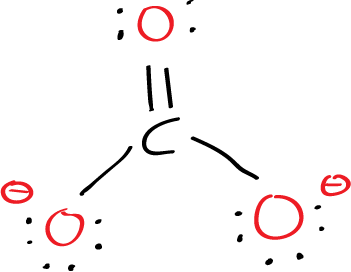
In this structure, the carbon atom is connected to three oxygen atoms, with one double bond and two single bonds. The remaining electrons are distributed as lone pairs on the oxygen atoms.
The negative charge on the ion is located on two of the oxygen atoms, to indicate that it has gained two electrons and achieved a stable octet configuration.
Resonance Structures of CO32-
The Lewis structure of the carbonate ion is best represented through resonance. The double bond shown in a single static diagram does not stay fixed between the carbon and one specific oxygen atom. Instead, it delocalizes across all three oxygen atoms.
Consequently, the true structure is a resonance hybrid of three equivalent contributors. Because of this electron delocalization, all three carbon-oxygen bonds are identical in length and strength, with a bond order of approximately 1.33.
Formal Charges Calculation
Calculating the formal charges for CO32- is a crucial step to verify the stability of the Lewis structure. The formula is: Formal Charge = Valence Electrons – (Non-bonding electrons + Number of bonds).
- Central Carbon (C): 4 valence electrons – (0 non-bonding electrons + 4 bonds) = 0
- Double-bonded Oxygen (O): 6 valence electrons – (4 non-bonding electrons + 2 bonds) = 0
- Single-bonded Oxygen (O) (x2): 6 valence electrons – (6 non-bonding electrons + 1 bond) = -1
The sum of these formal charges (0 + 0 – 1 – 1) equals -2, which perfectly matches the overall charge of the carbonate ion.
Molecular Geometry and Bond Angles
According to the VSEPR (Valence Shell Electron Pair Repulsion) theory, the central carbon atom in the carbonate ion has three electron domains (three bonding pairs and zero lone pairs). This corresponds to an AX3 system.
Therefore, the CO32- ion has a trigonal planar molecular geometry. Because the three electron domains repel each other equally to minimize repulsion, the bond angles are exactly 120°. This symmetrical shape plays a significant role in the ion’s physical and chemical properties.
How to Draw the Lewis Structure for CO32- (Carbonate Ion)
Full Professor of Organic Chemistry at the University of Granada, with a long-standing research career in Computational Chemistry and molecular modeling and design.